Peak Energy Times of Day: Your Biology's Schedule


Most people find their best ideas in the shower, at 11 p.m., or on a Tuesday for no apparent reason. That's not inspiration. That's biology running on a schedule you never saw the memo for.
Your body produces different hormones, different body temperatures, and different neurotransmitter ratios at different hours of the day — with a precision that puts most calendars to shame. Cortisol spikes before you open your eyes. Testosterone peaks in early morning. Core temperature hits its ceiling in the late afternoon. Each shift moves your cognitive abilities, physical strength, and emotional stability in specific, measurable directions.
Yet most people schedule their most demanding work based on whatever's free on the calendar, drink coffee when they're tired, and then wonder why some days feel effortless and others feel like thinking through wet concrete. The answer is rarely motivation. It's almost always timing. Your peak energy times of day follow a biological pattern. Once you understand it, the shape of a productive day becomes far less mysterious.
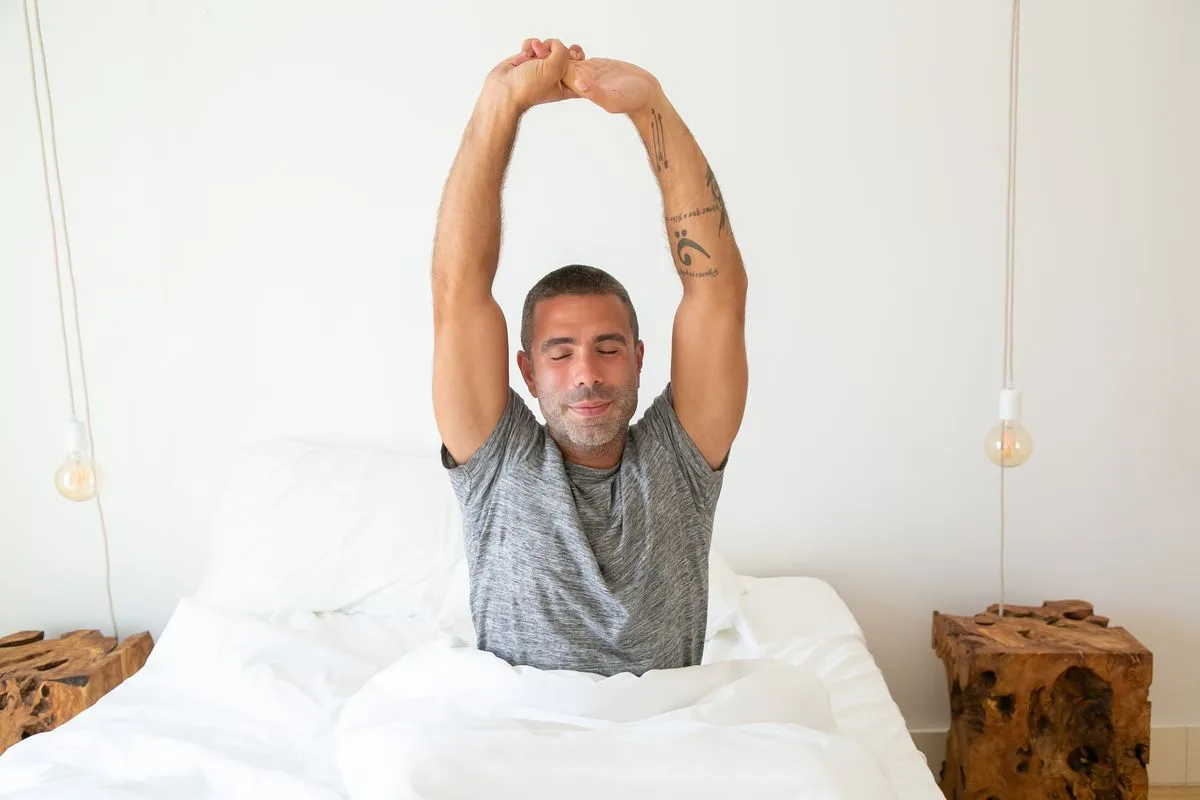
Here's something most people don't know: cortisol isn't the enemy.
The hormone gets a bad reputation because of its role in chronic stress. But its morning surge — called the Cortisol Awakening Response, or CAR — is one of your most useful biological tools. Within 30 to 45 minutes of waking, cortisol levels rise sharply, peaking at roughly 50–100% above baseline. This isn't stress. It's your body calibrating its systems for the day ahead.
Research published in Psychoneuroendocrinology by researchers at the University of Trier has shown that the CAR correlates directly with working memory performance and the ability to hold and manipulate information — the cognitive functions you need most for planning, writing, decision-making, and anything requiring focused attention.
This morning cortisol window, running roughly from 6 to 10 a.m. for people who wake between 6 and 7 a.m., represents your brain at peak alertness for structured, analytical thinking. It's also when your prefrontal cortex — the part responsible for judgment, impulse control, and complex reasoning — is most reliably online.
The common mistake is filling this window with email. You're spending your sharpest cognitive hours on other people's priorities, which means by the time you get to your actual work, the window has closed and you're running on fumes.
One counter-intuitive note: sunlight within 30 minutes of waking amplifies the CAR. Research by Andrew Huberman's lab at Stanford showed that morning light exposure through the eyes (not through glass) accelerates the cortisol rise and sets the circadian clock more precisely. Ten minutes outside — not even direct sun — measurably sharpens the morning peak.

If the morning cortisol window is the warm-up, the late morning is the performance.
Between 10 a.m. and noon, several biological processes converge. Core body temperature, which began rising at wake time, has climbed enough to optimize neural conduction speed. Alertness hormones are still elevated. The adenosine load — the sleep pressure chemical that accumulates throughout the day — hasn't yet built up to the point of dragging you down. Your reaction time is close to its daily fastest. Working memory capacity is near its ceiling.
A landmark study by Carolyn Anderson and colleagues at the University of Toronto, published in Psychological Science in 2014, tracked cognitive performance across age groups throughout the day. The finding that mattered most: for the kind of analytical, critical thinking that requires holding multiple pieces of information in mind simultaneously, late morning consistently outperformed afternoon — regardless of whether participants considered themselves morning people.
This is the window for your hardest work. Not your busiest work. Your hardest: the writing that requires real precision, the analysis that demands you hold three things in your head at once, the decision with downstream consequences. Research by Christoph Randler at the University of Education Heidelberg reinforces this — even confirmed night owls showed peak analytical performance shifted toward late morning, just delayed by one to two hours relative to morning types.
The practical implication: block 10 to 12 for deep work, not meetings. Meetings are fine later. The cognitive window is not renewable on demand.

This is the most misunderstood part of the day.
The post-lunch dip is real, but it's not caused by lunch. Researchers including Francesco Cappuccio at the University of Warwick have demonstrated through field studies that the early afternoon alertness dip occurs at similar intensity in people who ate lunch and those who skipped it entirely. It's circadian — a built-in downregulation that appears in temperature curves, melatonin fluctuations, and reaction time data across human populations worldwide.
Between 1 and 3 p.m., most people experience a 2–4% drop in core body temperature, a small but measurable rise in melatonin, and a corresponding dip in reaction speed, working memory, and motivation. Pushing hard cognitive work into this window is like trying to sprint uphill.
But here's the part most people miss: this trough is an opportunity in disguise.
First, if you let yourself rest — and especially if you nap — you can reset the afternoon for a second performance window. A 10-to-20 minute nap during this dip is more restorative than another 20 minutes of grinding through work. Sleep researcher Sara Mednick at UC San Diego, in studies published in Nature Neuroscience, showed that even brief napping during the circadian trough preserves afternoon cognitive capacity in ways that caffeine cannot replicate. The reason: sleep clears adenosine buildup, while caffeine only blocks the receptor temporarily.
Second, this is your window for creative, associative thinking. The slight cognitive looseness of the trough — less rigid prefrontal control, more diffuse processing — actually helps with brainstorming, lateral connections, and tasks where you don't need precision but do need ideas.

Your muscles don't follow the same schedule as your brain, and the divergence is more dramatic than most people realize.
Peak physical performance for most adults lands between 3 and 6 p.m. Core body temperature reaches its daily maximum around 5 p.m., and this matters enormously for athletic output. Muscle strength, reaction time, lung capacity, and cardiovascular efficiency all track closely with core temperature. A 2019 meta-analysis in the Journal of Strength and Conditioning Research synthesizing data from 33 studies found that peak muscle strength occurred in the late afternoon in the majority of participants, with average strength improvements of 7-8% over morning baseline.
Injury risk also follows temperature. Warm muscles are more elastic and less susceptible to tears. The same movement that pulls a hamstring at 7 a.m. won't cause the same damage at 5 p.m. This is why, if you look at world record performances in strength and speed events, a disproportionate number are set in late afternoon competition slots.
But the late afternoon peak isn't only physical. For many people, there's a secondary cognitive lift here — less sharp than the morning peak, but particularly suited for tasks requiring verbal fluency, social intelligence, and negotiation. Research by Tina Sundelin at the Karolinska Institute has shown that emotional reading of faces and social cue detection tend to perform better in the afternoon than the morning, when the brain is in a more rigid, task-focused mode.
This makes late afternoon the natural window for client calls, collaborative work, and anything requiring you to read and respond to people — not just information.
By early evening, your biology is making a clear argument for one thing: stopping.
As sunlight fades, the suprachiasmatic nucleus — your master circadian clock in the hypothalamus — triggers melatonin release from the pineal gland. Core body temperature begins its nightly descent. Cortisol drops toward its daily low. The prefrontal cortex becomes gradually less efficient at analytical tasks, while the brain shifts toward consolidation mode: processing the day's experiences, filing memories, making emotional sense of events.
This isn't a deficiency. It's design.
The evening hours have their own value — just not for deep cognitive work. Low-demand creative tasks, reading, music, physical movement without performance goals, conversations that don't require decisions: these fit the evening physiology. Forcing analytical work into this window doesn't just produce worse output — it actively delays sleep onset by keeping cortisol and alertness systems engaged when they're trying to wind down.
The specific threat is artificial light after 8 p.m. Research by Charles Czeisler at Harvard Medical School, published in PNAS in 2014, demonstrated that exposure to evening blue light (from screens, LEDs, and overhead lighting) suppresses melatonin production by up to 50%, delays circadian phase by an average of 1.5 hours, and reduces the amount of REM sleep the following night. Every night this pattern repeats, the delay compounds — shifting your biological peak energy times systematically later without changing your wake time.
The practical implication isn't "avoid screens forever." It's understanding that your evening choices are actually morning choices. What you do after 8 p.m. directly determines whether your 10 a.m. cognitive peak tomorrow is sharp or blunted.
The schedule above reflects population-level averages for intermediate chronotypes — people who wake naturally between 6 and 7:30 a.m. If you're a confirmed early type, shift everything 1–2 hours earlier. If you're a confirmed late type, shift it 1–3 hours later. The shape stays the same; the clock times move. What doesn't change across chronotypes is the logic: a morning analytical peak, a midday trough, a secondary physical and social peak in the afternoon, and an evening descent. The gradient is biological, not motivational. You can work with it or against it, but you can't eliminate it.
The most productive shift most people can make has nothing to do with discipline or habit stacking or morning routines. It's simpler: protect your peak hours the way you'd protect a flight you can't miss. Put your hardest work there. Let the rest of the day organize around that single constraint.
Biology gave you a schedule. It just forgot to send the calendar invite.
Start tracking your own energy peaks for one week — no app needed. Note the hour and your subjective focus level (1–10) three times a day. The pattern usually becomes clear within three days, and it's rarely what you expected.
You don’t have to take my word for it — check it in practice. Get my author’s checklist “5 non-obvious signs that your biorhythms are off” and start the path to recovery today.
Get a checklist and make an appointment